
A New Kind of Police Protection

Flex Cop & The Dork Police

Below is a holiday gift of two stories from my book “Sweet Fruit from the Bitter Tree.” Just yesterday the second story got a request from Macmillan Learning to be included in a popular text book with an expected print distribution of 175,000 hardcover copies and 25,000 ebooks!

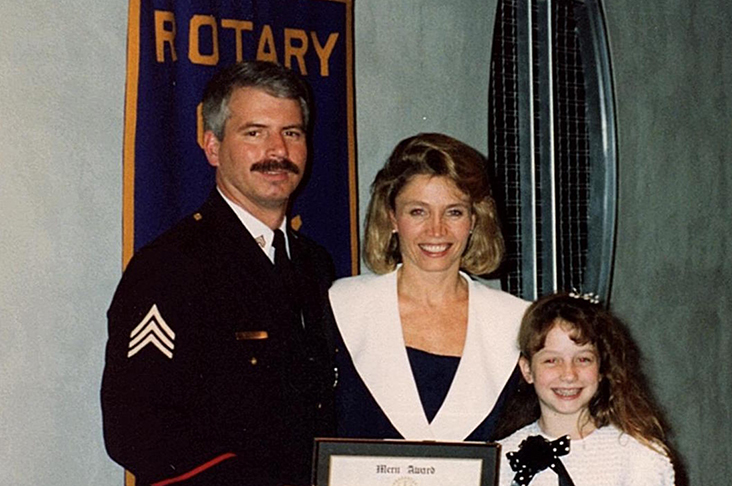
These two stories by Michael Gardner—a former police officer with a 30-year police career—show amazing creativity and outside-the-box thinking, as he was called on to deal with domestic violence and other situations where his own life, and the lives of community members, were on the line. I hope you’ll find these stories as inspirational as I do, at a time when police shootings regularly make the news, and we are struggling as a nation for the best ways to keep our communities safe.

When I interviewed Michael Gardner I was immediately struck not only by his obvious creativity and flexibility in responding to conflicts, but also by his warmth and generosity. He told me story after story of dangerous police calls that he responded to with highly unusual—and just as effective—ways of resolving conflicts. I felt honored to hear these incredible stories straight from the source, and yet Michael was such an appreciative person that he kept thanking me for my small part in recording people’s stories of creative conflict resolution. I think Michael’s humility and obvious caring for others is a large part of what led him to become one of the “Dork Police,” and have no qualms about trying out things that many might pre-judge as “stupid” or “weak” or “unprofessional.” As a police officer, Michael remained focused on the outcome—to increase his own and others’ safety—and by this measurement his methods were not only smart and strong, but also, I hope, a new model for professionalism.

Without further ado, click here for Flex Cop: A Police Officer's Creative Approach to Conflict free from Amazon.

You can also download it free from Barnes & Noble, Smashwords, Kobo and iBooks. This booklet will remain free forever, so you can share these stories with friends and loved ones.

If you’re looking for an inspiring Christmas gift, check out the full book “Sweet Fruit from the Bitter Tree: 61 stories of creative and compassionate ways out of conflict," in both paperback and ebook.

Wishing you a great holiday season!

~Mark

Improve Your Communication: Clarity through Curiosity

Sometimes all that’s needed is the right kind of listening

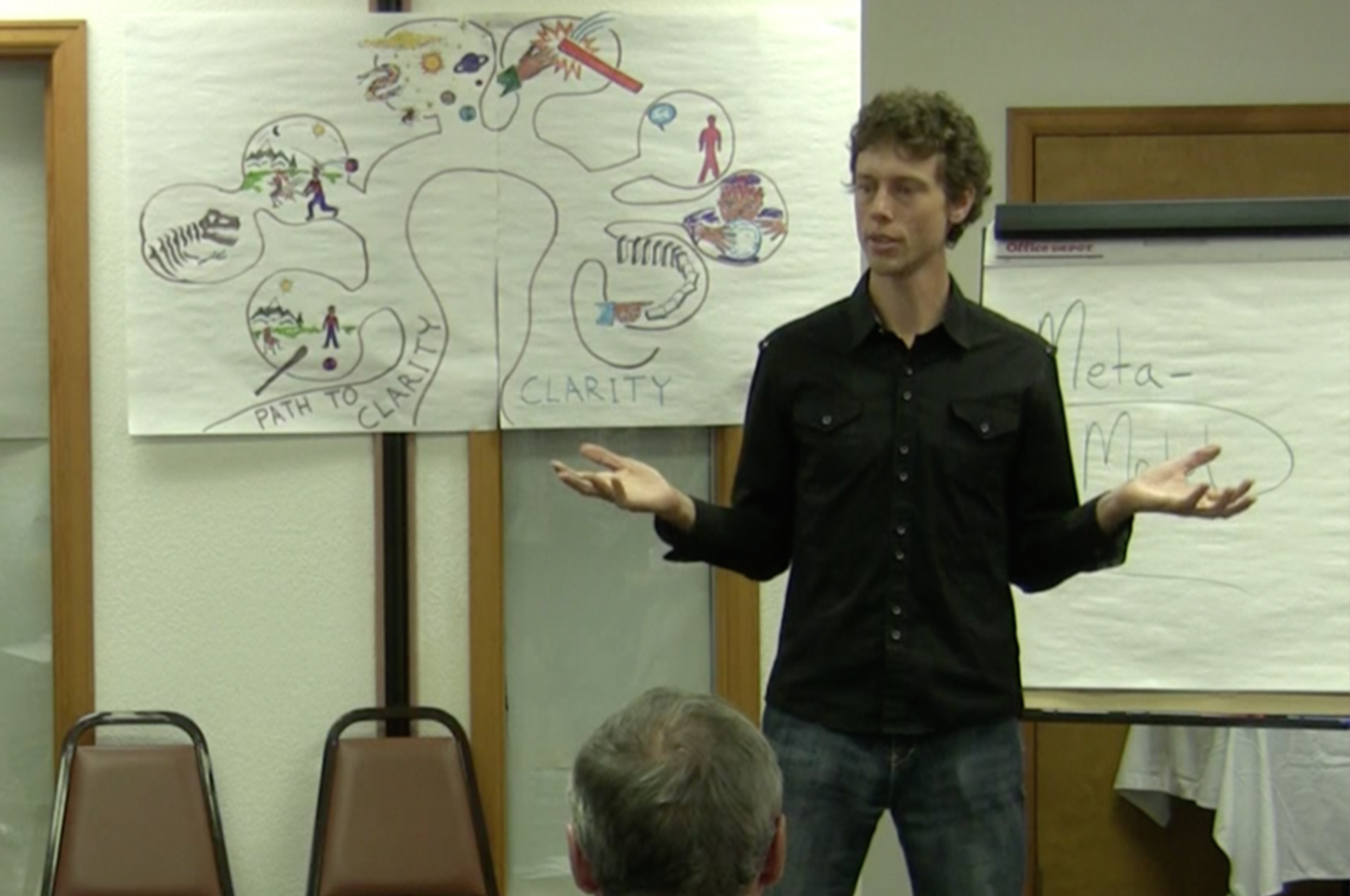
Last month I taught the Meta Model in an NLP Practitioner Training in Winter Park, CO. For those of you unfamiliar with the Meta Model, in a nutshell the Meta Model is all about being curious and gathering detailed information about someone else’s experience, rather than simply filling in the gaps ourselves and assuming we know what the other person is talking about. For example, When someone tells you “I just went on vacation,” you get a certain image in your mind. Then when they say, “It was great, I just wish I’d brought another down parka,” you may be wondering what the heck they’re talking about. Likely as not you didn’t start off by picturing a vacation place cold enough to require even a single down parka, much less two, but it turns out their vacation was climbing Mount Everest. Information gathering is key before beginning any personal change process so that we make sure we don’t try to “fix” something that wasn’t ever broken.

For example, I had a client come and see me and the first thing he said was, “I want to get my acupuncture business going, but I can’t get motivated to start it.” At this point I could have asked no more and simply jumped right in using one of a number of NLP change processes to give him the motivation he lacked. Instead, I started by being curious about this other person’s unique experience, and I asked questions to gather more information about him rather than assuming I already understood.

“What stops you from being motivated?” I asked.

He told me he already had another full-time business that he ran, and a family with three kids with whom he wanted to spend more time. He also had travel goals he wanted to accomplish, a daily health and fitness plan that was important to him… The more I listened, the more I realized this was not an unmotivated person. If I hadn’t asked these questions, I might have pictured him sitting around on the couch all day watching TV, but in fact he was doing all sorts of things that were important to him. He simply didn’t have the time to do everything he wanted to do. This wasn’t about motivation, it was about prioritization.

“It sounds like you have a lot you’re already doing,” I said, “And stepping into your shoes, I’m starting to feel pretty unmotivated myself. If I were living your life I don’t think I’d want to add a whole new business into the mix, unless I let go of something else. But as I listen to you, it sounds like everything else you’re doing in your life is really important to you. So I’m wondering, what would happen if you simply decided to wait 6 months to even think about starting that acupuncture business? What would happen if you wrote a note in your calendar six months out that says, “Check in about acupuncture business.” Then you could forget about it for six months, knowing that 6 months from now you’ll see that note and be able to decide then whether it’s the right time to start it, or whether it still makes sense to postpone it another 6 months.”

“Oh, man,” he said, “I feel relieved already!” We were talking on the phone, and I could hear the relief in his voice. “I’ve had this anxious knot in my chest for the last couple months,” he added. “When you offered that suggestion the knot just relaxed and melted away. I feel great! You’re right. Everything else in my life is more important to me right now, and as much as I’d love to start that new acupuncture business, now’s just not the right time. Thank you so much!”

That was all we did. If I had rushed on to an NLP change process to give him motivation, it would have either failed due to not being a good match for his actual problem, or worse it might have succeeded, adding much more conflict and stress into his life by taking time away from his wife and kids as well as his other business and his personal goals.

Work with Me: Looking for one-on-one coaching? Apply to work with me here.


Helping others gain clarity by listening with curiosity

The next time you encounter a friend who has a problem, pause before trying to challenge it (“That’s not true, people love you”) or fix it (“Well, what I do is this…”). First, see what happens when you simply listen with curiosity and empathy while asking clarifying, information-gathering questions such as:

“What happened…?” “When exactly…?” “Where…?” “Who specifically was there…?” “How did it happen…?” “How did he make you angry…?” “How do you know productivity is down…?” “Who is producing what and how are they doing it…?” “What stops you from already getting what you want…?” “What would happen if you did do it…?” “According to whom…? Who said it was impossible to heal…?” “Always…? Are there any times when it’s different…?”

Most people like sharing their experience, and will feel good when you ask more details about it rather than assuming you already know what they’re talking about. Let’s say a friend says, “All men are total jerks!” Instead of challenging the statement or offering a solution, see what happens when you ask clarifying, information-gathering questions like, “What men are jerks…? Was someone a jerk to you today…? Who…? How was he a jerk…?” When I ask these questions to get a clear picture of someone else’s experience, not only does it show them I’m interested in what they have to say, but it starts to clarify the picture for them also. They have to see a clearer picture in order to answer the questions. So just listening, and asking the right questions, is in itself a powerful intervention. The other person will begin to make more distinctions, such as who specifically was a jerk to them, and how. This clearer picture is something they can begin to do something about, whereas, “All men are jerks,” is a problem that no one can solve.

I hope you play with this and let me know what you discover.

A bit more about asking clarifying, information-gathering questions:

The right kind of information gathering ensures that we don’t work toward solving something that isn’t actually a problem, or give someone a “solution” they think they want, but which may actually make their life worse. While gathering this information, it’s important to do it from a place of connection and curiosity about the other person’s experience. This may seem obvious, but it wasn’t always taught this way.

Historically, the NLP Meta Model information-gathering questions have been taught as questions that can be used to “challenge” what the speaker is saying, and thus get the speaker to acknowledge a clearer and more detailed picture of reality. But “challenging” someone often doesn’t go over very well. No one likes to be cross examined. (Many people know what this is like from when their parents did it to them as kids.) If we use these clarifying questions with an agenda, or with a challenging or judgmental tone of voice, they will tend to backfire. The other person will tend to get defensive, concluding something like: “This person is being pretty insensitive, why should I listen to them?” or, “Yep, all men are jerks, and you are too!”

Luckily there is nothing inherently challenging or judgmental about any of the information-gathering questions. It’s all a matter of how you ask them. They can be experienced as an Inquisition, but they can also be experienced as the deepest form of empathy and care and connection. It all depends on the voice tone, body language and intent of the person asking the questions. Just remember a time when you had intense curiosity about an incredible story someone told you. A time when you just couldn’t stop asking questions about this story because you had to know all the details. Without knowing it, you were naturally using many of the Meta Model information-gathering questions. My guess is you were using these questions not in a challenging way, but with deep curiosity and connection with the storyteller.

When asked from a place of curiosity and connection, these information-gathering questions can be one of the best ways you can gain rapport with someone else. Sometimes the other person will even solve their problem on their own, due to the clarity they gained by responding to your curiosity.

Work with Me: Looking for one-on-one coaching? Apply to work with me here.

Eliminating Musical Performance Anxiety

“I finished the audition and only when I walked out did I realize: I had no teeth chattering, no sweating, no shaking at all! It was just so crazy. I didn’t expect it at all!”

Let’s rewind back to when I first met Maya. She was a bright high school student who played trombone in a highly-competitive orchestra. She was a great musician, and told me, “The number one thing I care about is music.” Whenever she had to audition or play solo during orchestra practice, she got intense performance anxiety. She started sweating, shaking, and her teeth would chatter—not at all helpful, especially when playing a brass instrument!

She was about to graduate and apply to music schools, where the pressure to perform and audition well would matter a lot. Understandably she wanted this solved.

Since she lived in another state, I met with Maya over Skype. During our first meeting I showed her the spinning feelings process. This got a great result for her. “This is like sorcery!” she said. But at our next meeting she told me, “When I had to solo twelve bars in orchestra practice, I couldn’t calm down quick enough. I can’t meditate for an hour before that type of situation; I need a quicker way.”

Though the spinning feelings process can be done quite quickly, in just a few minutes, I understood how it might be tough for her to focus while surrounded by people in the middle of a class. I asked her when the anxiety first started in the day. She said, “It’s here when I first wake up,” and she gestured to her sternum.

I decided to do some parts work with her. I told her the story from World War II about how Japanese soldiers were left on many different islands in the Pacific and told to defend the country no matter what. Isolated and cut off from their command, many of these soldiers continued to defend these islands long after the war was over. Now and then one would be found when he shot at a passing fishing boat. The last soldier was found some 18 years after the war had ended. All that time he had managed to survive, alone and isolated, while continuing to loyally fight to defend the safety of his country. The Japanese government could have laughed at him when they found him for continuing to fight when the war was over, but instead they thanked him for his loyal service, brought him home, held a ceremony in his honor. Only then did they begin to gently tell the soldier that the war was over, and he could now serve the country in other ways.

I told Maya, “We all have parts of ourselves that are like these Japanese soldiers, still fighting loyally on to protect us from a war that is long since over. And so we have an opportunity to thank them for their service and invite them back home.”

Maya gestured to her sternum again, where the anxiety had been, “Now it’s like there’s a plane there,” she said. “And it’s like there are tiny little Thors [Norse God of Thunder] getting off the plane. They started out one color, and as they got of the plane they turned to different colors: green, yellow, orange, red. It’s like all these tiny little Thors have new jobs.”

Well I hadn’t even started the parts work I had planned, and all this was already happening spontaneously. This is a testament to the power of telling stories. I could have simply communicated the conclusion of the story: “In NLP we have a presupposition that all parts of us create behaviors for some positive purpose, even if the behavior (anxiety) is causing us major problems.” If I had done this, it would have taken less time, but it would have only spoken to her conscious mind. Telling the story gave her an experience of the truth of the statement.

“There is clearly some nice shifting going on, and so you can already appreciate that, and be curious how the new jobs of these tiny Thors will benefit you,” I said. It would have been interesting just to leave it at this, and see what happened just from telling her the story. I gave her the option: “We could leave it at this for now, with the tiny Thors with their new jobs, that may be all that’s needed for this session. Or if you want to do more, we can explore something in addition to what’s already happened.”

“Let’s explore,” she said.

“Up until now [presupposition that it can be different in the future] you’ve had a part of you that has generated anxiety, and you’ve had another part of you that doesn’t want to be anxious, haven’t you.”

“Yep.”

“So you can notice, in your body or around you, the part of you that up until now has generated anxiety, and you can invite it out into one of your hands. This part of you will know which is the hand that it wants to be in.”

Maya nodded, “It’s like Thor, coming into my right hand.”

“Great. Thank this Thor part for coming into your right hand. From what you said before, this part may have already found lots of great new jobs to do. Or maybe those were other Thor parts that found new jobs, and this one still wants new and better ways of getting what it wants for you. Either way is fine and you don’t even need to know consciously which it is. Just thank this Thor part for being here.”

She closed her eyes and nodded.

I said, “Now you can also notice the part of you that doesn’t want to be anxious, and you can invite this part of you to come into your other hand. ”

She said, “It’s like Loki [Norse trickster god].”

“Great, now we are going to find out what each of these parts really wants for you. Turn to your right hand and thank Thor for being there, and ask him, ‘What do you want?’ Then relax and notice what he responds with.

She nodded and closed her eyes, then said, “Thor wants me to do the right thing, all the time.”

“Great. Thank him for this response, and invite him to step into what it’s like to already have you doing the right thing, all the time.”

“Ok,”

“Now ask Thor, ‘When I’m doing the right thing all the time, what does this get for me that’s even more important?’ ”

“Peace of mind,” she answered.

“Thank this Thor part of you for this response, and now ask him, ‘When I have peace of mind, what does that get me that’s even more important?’ ”

“Then I have a clear view of what needs to happen.”

“Great, so what this part really wants for you, is for you to have a clear view of what needs to happen. Is this something you also agree is worth having?”

“Yes, totally.”

“Great. Now turn to the Loki part in your left hand, and ask Loki, ‘What do you want?’ ”

Maya turned to her left hand and closed her eyes. When she opened her eyes again, she said, “Loki wants me to just speak my mind, and other people can just suck it!”

“Great!” I said, “Now thank Loki for this response, and ask Loki, ‘When I speak my mind, and other people can just suck it, what does this get for me that’s even more important?’ ”

“It earns me confidence.”

“Ok, great. Thank Loki for this response. So what Loki really wants for you, is to earn you confidence. Is confidence something that you also agree is worth having?”

“Of course!”

“Great, now invite Thor and Loki each to have a look over at the other one. Up until now, they have both been struggling with each other, but now we know that what Loki really wants for you is confidence, and what Thor really wants for you is a clear view of what needs to happen. Ask Thor if confidence will also help him with what he wants: having a clear view of what needs to happen.”

“Yeah, it does.”

“Great. Now ask Loki if having a clear view of what needs to happen is in support of the confidence that Loki wants.”

“Absolutely!”

“So by working together, Loki and Thor can each get what they want for you much more easily. Go ahead and allow your hands to come together only as fast as Loki and Thor learn how to work together to support each other in getting what both want for you.”

“Yeah…” She kept her eyes closed for a while, clearly processing. When she opened her eyes she said, “Thor and Loki turned into Sherlock and Watson! It’s like they’re working together now, untying knots. Like solving the puzzles.”

“Wow, wonderful! Now go ahead and bring Sherlock and Watson into your body, so that they can integrate and become a natural part of you, working together in this new way.”

She did so.

Then I said, “Now, mentally step into a past situation where you used to have performance anxiety, and notice how it goes now, with this new way of being?”

“Now it’s just no big deal,” she said.

I then asked her to step into a future example, and she also said of that: “It’s no big deal.”

“Now,” I said, “It’s likely that some echoes of the old anxiety will happen in the future, but that they will become less frequent and less intense. If something comes back more intense, it’s just a sign that you have another part that also wants something positive for you, and also wants to be included.”

Before ending the session, Maya agreed she would continue to do the spinning feelings process at night when she went to bed, to help her relax for sleep (which she often struggled with, staying up really late).

The third time we met, Maya said the spinning feelings helped her go to sleep easily at night. “When I came back home from work I just went right to sleep,” she said, which was very different from her prior pattern of staying up late before managing to fall asleep.

As far as the performance anxiety, she hadn’t yet had any more auditions or solo performances, so we still didn’t have a real-world test of the work we’d done last session. Because of this, we focused on some other goals of hers. One thing she wanted was a solution to her headaches. She told me she sometimes got headaches that commonly lasted around three hours, making her feel numb, numbing her left hand, and causing her to temporarily lose vision in her left eye. I taught her the rewinding process to try for her headaches, telling her how much it had helped me with my Athsma-like condition that the doctors hadn’t been able to diagnose.

The fourth time I met with Maya was a week before a big audition for a local youth symphony. To test the previous work we had done, I asked her to close her eyes and imagine waking up on the morning of the audition. “Now just play through the day and find out how it goes.”

“It was like I was just practicing,” Maya said.

“Great. I know that you play beautifully when you practice, so if it can be like that, that sounds like a good thing to me.” To be thorough and find if there were any additional resources that would help her, I got even more specific, “Do you know where the audition will take place?”

“Yes.”

“Great, do you know the room?”

“Yes.”

“Great, now close your eyes and imagine going through this whole week, waking up on audition day and going to the place where it will be held and finding the room. Now, as you walk through the door, how does it feel?”

When she opened her eyes she said, “One fourth great, one fourth real, one fourth I don’t know, and one fourth get me out.”

We did Core Transformation with this remaining “get me out” fourth, and concluded the session.

When I met with Maya the fifth time, she was really excited to tell me what had happened the previous week: “Ok,” She said. “I have a lot to tell you. So when I went to my audition, first off I had the audition at 8:42, but I arrived at 8:00am. When I got there, my headache started, so I’m like, Seriously? Is this really happening right now? Anyway I did the rewinding thing you taught me, and it totally improved it, and the headache went away completely after about 45 minutes rather than the usual around 3 hours!”

“So anyway,” Maya continued, “not long after I did the rewinding I was called for my audition. For some reason they called me like 15 minutes earlier than my scheduled time! Normally I would have protested this, but I just went with it. Then on top of this unexpected timing, the judge was pretty grumpy, and I still had a little of the headache happening. Anyway, I finished the audition and only when I walked out did I realize: I had no teeth chattering, no sweating, no shaking at all! It was just so crazy. I didn’t expect it at all!”

We met a few more times after this, working on some other goals of hers. Since then I’ve tried to get long-term feedback on her experience with auditions and playing solo, but so far I haven’t heard back from her.


Putting it into Practice: Parts Integration
(See the book Heart of the Mind for an in-depth version of this process):

  1. When you find yourself wanting something that you don’t yet have (especially if it’s a bit extreme), often there will be another part that wants the opposite. For example: a part that wants to exercise all the time, and a part that wants to be lazy and lie around all day; a part that wants to eat all raw, organic, grass-fed, omega-3 foods, and a part that wants to pig out on Doritos, soda, and pizza hut; a part that wants to be polite and friendly, and a part that just wants to say screw you; a part that feels anxious, and a part that wants to be calm.
  2. Notice where you feel each part, in your body or around you. Thank each of these parts for being here, because you can trust that they each have something positive they want for you.
  3. Open your hands, palms upward, and invite one part to flow into one hand, and the other part to flow into the other hand. It doesn’t matter which part is in which hand, though each will tend to go to the hand that feels right for it.
  4. Now start with one part and ask it, “What do you want?” Then relax, close your eyes, and notice what response comes back from that part. Thank it for this response, and ask it, “And when you get what you want, what does this get for me that’s even more important?” Thank it for this response, and continue this cycle until the part arrives at a value (such as happiness, peace, health, integrity) that is something you can agree on, and that the other part is likely to also agree is a good thing. (Hint: the longer you do this cycle, the more likely it will be that you arrive at a value that is also appreciated by yourself and the other part, so when in doubt, keep going.)
  5. Repeat step 4 with the other part in the other hand.
  6. Now invite each part to look over at the other part. Ask each part if it recognizes the value in what the other part is really wanting to get for you. If you have gone to a deep enough (or high enough) value, each part will recognize that the value of the other part is also a good thing, and not in conflict with it’s own value.
  7. Say to the parts, “Now that you both see and recognize what each of you are really trying to get, and you both agree that both of these values are worth having, how would you like to work together in mutual support of achieving these values?
  8. If the answer is “no,” first satisfy the objection, or look back at what might have been missed in a previous step. If the answer is “yes” (which it usually is), invite both of your hands to come together only as quickly as these two parts of yourself learn to work together in new ways—many of them unconscious to you—to achieve both values.
  9. Once your hands come together, bring them into your body wherever feels right, usually the heart or chest area, so these cooperating parts can integrate back in with you.
  10. Test back in the initial scenario and find out how it goes now, with the cooperating parts within you. If it goes well, great! If not, address any concerns or objections until it goes well.
  11. Step into future situations, noticing what is changed for you now that these parts are working together in this new way.

Work with Me:

Ready to move beyond the same stuck patterns and create real, lasting change?

Tell me what you most want to shift, and if it’s a fit, I’ll reach out to offer a complimentary 30‑minute discovery call → Apply to work with me